图的访问与存储—临接表
一、基本结构
二、临接表示例
1.无向图的邻接表
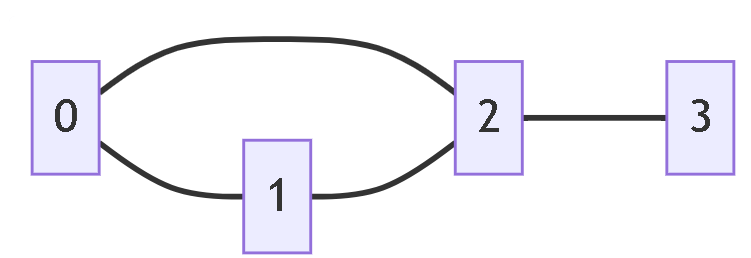
如果上面的图用临接矩阵表示,那么便是一个4*4的矩阵
| 顶点 | 0 | 1 | 2 | 3 |
|---|---|---|---|---|
| 0 | 0 | 1 | 1 | 0 |
| 1 | 1 | 0 | 1 | 0 |
| 2 | 1 | 1 | 0 | 1 |
| 3 | 0 | 0 | 1 | 0 |
如果是临接表,那么可以看出一共有4个顶点0、1、2、3
每个顶点都有“邻居”(邻居数组)。
比如顶点0,它的邻居数组是[1,2]
顶点1,它的邻居数组是[0,2]
顶点2,它的邻居数组是[0,1,3]
顶点3,它的邻居数组是[2]
表示成下面这样:
0 → [1, 2] 1 → [0, 2] 2 → [0, 1, 3] 3 → [2]
参考代码:
#include <iostream> #include <vector> using namespace std; // 创建无向图的邻接表 vector<vector<int> > createUndirectedGraph(int numVertices) { return vector<vector<int> >(numVertices); } // 添加无向边 void addUndirectedEdge(vector<vector<int> >& graph, int u, int v) { graph[u].push_back(v); graph[v].push_back(u); } // 打印邻接表 void printGraph(const vector<vector<int> >& graph) { cout << "无向图邻接表:" << endl; for (int i = 0; i < graph.size(); i++) { cout << "顶点 " << i << " -> "; // 循环遍历邻居 for (int j = 0; j < graph[i].size(); j++) { cout << graph[i][j] << " "; } cout << endl; } } // 计算每个顶点的度 vector<int> calculateDegrees(const vector<vector<int> >& graph) { vector<int> degrees(graph.size(), 0); for (int i = 0; i < graph.size(); i++) { degrees[i] = graph[i].size(); } return degrees; } // 检查两个顶点之间是否有边 - 使用传统for循环 bool hasEdge(const vector<vector<int> >& graph, int u, int v) { for (int j = 0; j < graph[u].size(); j++) { if (graph[u][j] == v) { return true; } } return false; } // 删除无向边 void removeUndirectedEdge(vector<vector<int> >& graph, int u, int v) { // 删除 u->v 的边 for (int j = 0; j < graph[u].size(); j++) { if (graph[u][j] == v) { graph[u].erase(graph[u].begin() + j); break; } } // 删除 v->u 的边 for (int j = 0; j < graph[v].size(); j++) { if (graph[v][j] == u) { graph[v].erase(graph[v].begin() + j); break; } } } int main() { // 创建无向图 vector<vector<int> > graph = createUndirectedGraph(6); // 添加边 addUndirectedEdge(graph, 0, 1); addUndirectedEdge(graph, 0, 2); addUndirectedEdge(graph, 1, 3); addUndirectedEdge(graph, 1, 4); addUndirectedEdge(graph, 2, 4); addUndirectedEdge(graph, 3, 5); // 打印图 printGraph(graph); cout << endl; // 计算顶点度 vector<int> degrees = calculateDegrees(graph); for (int i = 0; i < degrees.size(); i++) { cout << "顶点 " << i << " 的度: " << degrees[i] << endl; } cout << endl; // 检查边 cout << "检查边 0-1: " << (hasEdge(graph, 0, 1) ? "存在" : "不存在") << endl; cout << "检查边 0-3: " << (hasEdge(graph, 0, 3) ? "存在" : "不存在") << endl; cout << endl; // 删除边 cout << "删除边 0-1 后:" << endl; removeUndirectedEdge(graph, 0, 1); printGraph(graph); return 0; }2.有向图的临接表
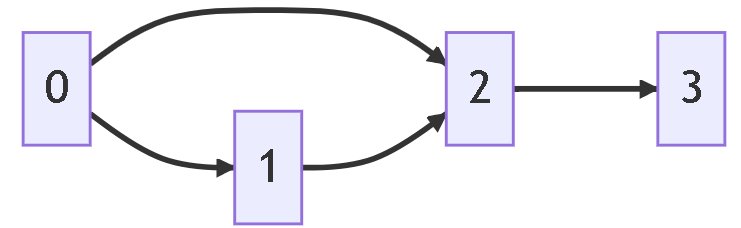
对于上面这个有向图,如果用临接矩阵表示,是一个4*4的临接矩阵,如下所示
| 顶点 | 0 | 1 | 2 | 3 |
|---|---|---|---|---|
| 0 | 0 | 1 | 1 | 0 |
| 1 | 0 | 0 | 1 | 0 |
| 2 | 0 | 0 | 0 | 1 |
| 3 | 0 | 0 | 0 | 0 |
如果是临接表,那么有4个顶点0,1,2,3
对于顶点0来说,它的邻居数组是[1,2]
对于顶点1来说,它的邻居数组是[2]
对于顶点2来说,它的邻居数组是[3]
对于顶点3来说,它的邻居数组是[]
表示成下面
顶点0: [1, 2] // 0指向1、2 顶点1: [2] // 1指向2 顶点2: [3] // 2指向3 顶点3: [] // 3无出边
参考代码
#include <iostream> #include <vector> using namespace std; // 创建有向图的邻接表 vector<vector<int> > createDirectedGraph(int numVertices) { return vector<vector<int> >(numVertices); } // 添加有向边 void addDirectedEdge(vector<vector<int> >& graph, int from, int to) { graph[from].push_back(to); } // 打印邻接表 void printGraph(const vector<vector<int> >& graph) { cout << "有向图邻接表:" << endl; for (int i = 0; i < graph.size(); i++) { cout << "顶点 " << i << " -> "; // for循环遍历出边 for (int j = 0; j < graph[i].size(); j++) { cout << graph[i][j] << " "; } cout << endl; } } // 计算每个顶点的出度 vector<int> calculateOutDegrees(const vector<vector<int> >& graph) { vector<int> outDegrees(graph.size(), 0); for (int i = 0; i < graph.size(); i++) { outDegrees[i] = graph[i].size(); } return outDegrees; } // 计算每个顶点的入度 vector<int> calculateInDegrees(const vector<vector<int> >& graph) { vector<int> inDegrees(graph.size(), 0); for (int i = 0; i < graph.size(); i++) { for (int j = 0; j < graph[i].size(); j++) { int target = graph[i][j]; inDegrees[target]++; } } return inDegrees; } // 检查是否有从u到v的有向边 - 使用传统for循环 bool hasDirectedEdge(const vector<vector<int> >& graph, int from, int to) { for (int j = 0; j < graph[from].size(); j++) { if (graph[from][j] == to) { return true; } } return false; } // 删除有向边 - 使用传统for循环 void removeDirectedEdge(vector<vector<int> >& graph, int from, int to) { for (int j = 0; j < graph[from].size(); j++) { if (graph[from][j] == to) { graph[from].erase(graph[from].begin() + j); break; } } } int main() { // 创建有向图 vector<vector<int> > graph = createDirectedGraph(6); // 添加有向边 addDirectedEdge(graph, 0, 1); addDirectedEdge(graph, 0, 2); addDirectedEdge(graph, 1, 3); addDirectedEdge(graph, 2, 1); addDirectedEdge(graph, 2, 4); addDirectedEdge(graph, 3, 5); addDirectedEdge(graph, 4, 3); addDirectedEdge(graph, 4, 5); // 打印图 printGraph(graph); cout << endl; // 计算出度和入度 vector<int> outDegrees = calculateOutDegrees(graph); vector<int> inDegrees = calculateInDegrees(graph); for (int i = 0; i < graph.size(); i++) { cout << "顶点 " << i << " - 出度: " << outDegrees[i] << ", 入度: " << inDegrees[i] << endl; } cout << endl; // 检查有向边 cout << "检查边 0->1: " << (hasDirectedEdge(graph, 0, 1) ? "存在" : "不存在") << endl; cout << "检查边 1->0: " << (hasDirectedEdge(graph, 1, 0) ? "存在" : "不存在") << endl; cout << "检查边 2->4: " << (hasDirectedEdge(graph, 2, 4) ? "存在" : "不存在") << endl; cout << endl; // 删除边 cout << "删除边 0->2 后:" << endl; removeDirectedEdge(graph, 0, 2); printGraph(graph); return 0; }3.带权图的邻接表
邻接表需存储 “邻居顶点 + 权重”(通常用二元组 / 结构体):
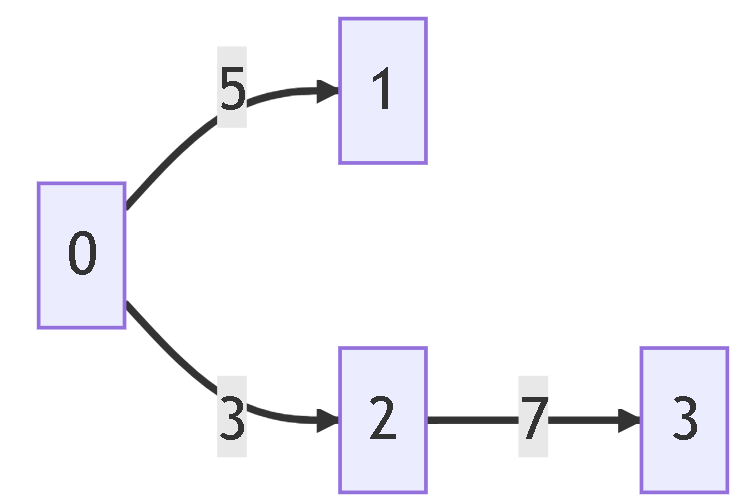
对于这个带权图,如果是临接矩阵,那么是4*4的临接矩阵,表示成下面这样
| 顶点 | 0 | 1 | 2 | 3 |
|---|---|---|---|---|
| 0 | 0 | 5 | 3 | 0 |
| 1 | 0 | 0 | 0 | 0 |
| 2 | 0 | 0 | 0 | 7 |
| 3 | 0 | 0 | 0 | 0 |
如果是临接表进行表示,
顶点0: [(1,5), (2,3)] 顶点1: [] 顶点2: [(3,7)] 顶点3: []
带有权重的图可以使用pair来表示
适用于有向、带权重的场景(如路径长度、费用),用 pair<int, int> 存储「邻居顶点 + 权重」(第一个元素 = 邻居,第二个 = 权重)。
参考答案:
#include <iostream> #include <vector> #include <utility> using namespace std; //添加带权边 void addEdgeToGraph(vector<vector<pair<int, int>>>& adj, int u, int v, int weight) { adj[u].push_back(pair<int, int>(v, weight)); } //打印 void printGraph(vector<vector<pair<int, int>>>& adj) { for (int i = 0; i < adj.size(); ++i) { cout << "顶点 " << i << " 指向:"; vector<pair<int, int>> edges = adj[i]; for (int j = 0; j < edges.size(); ++j) { int neighbor = edges[j].first; int weight = edges[j].second; cout << "(" << neighbor << ", 权重" << weight << ") "; } cout << endl; } } int main() { // 4个顶点 二维向量 vector<vector<pair<int, int>>> graphAdj(4); // 添加边(此时graphAdj已有0-3共4个顶点,访问合法) addEdgeToGraph(graphAdj, 0, 1, 13); //加入边和权重 addEdgeToGraph(graphAdj, 0, 2, 14); addEdgeToGraph(graphAdj, 1, 2, 15); addEdgeToGraph(graphAdj, 2, 3, 16); addEdgeToGraph(graphAdj, 3, 1, 17); cout << "=== 有向带权图===" << endl; printGraph(graphAdj); cout << endl; return 0; }.jztagtree{max-height:85vh;right:0px}.jzDown{top:10vh}.jztagtree li a{background-color:#448EF6}.jztagtree li a:before{border-right:10px solid #448EF6}.jztagtree li a:hover{background:#0045a6}.jztagtree li a:hover::before{border-right:10px solid #0045a6}
$("#jztoc").toc({content: ".single", headings: "h1,h2,h3"});